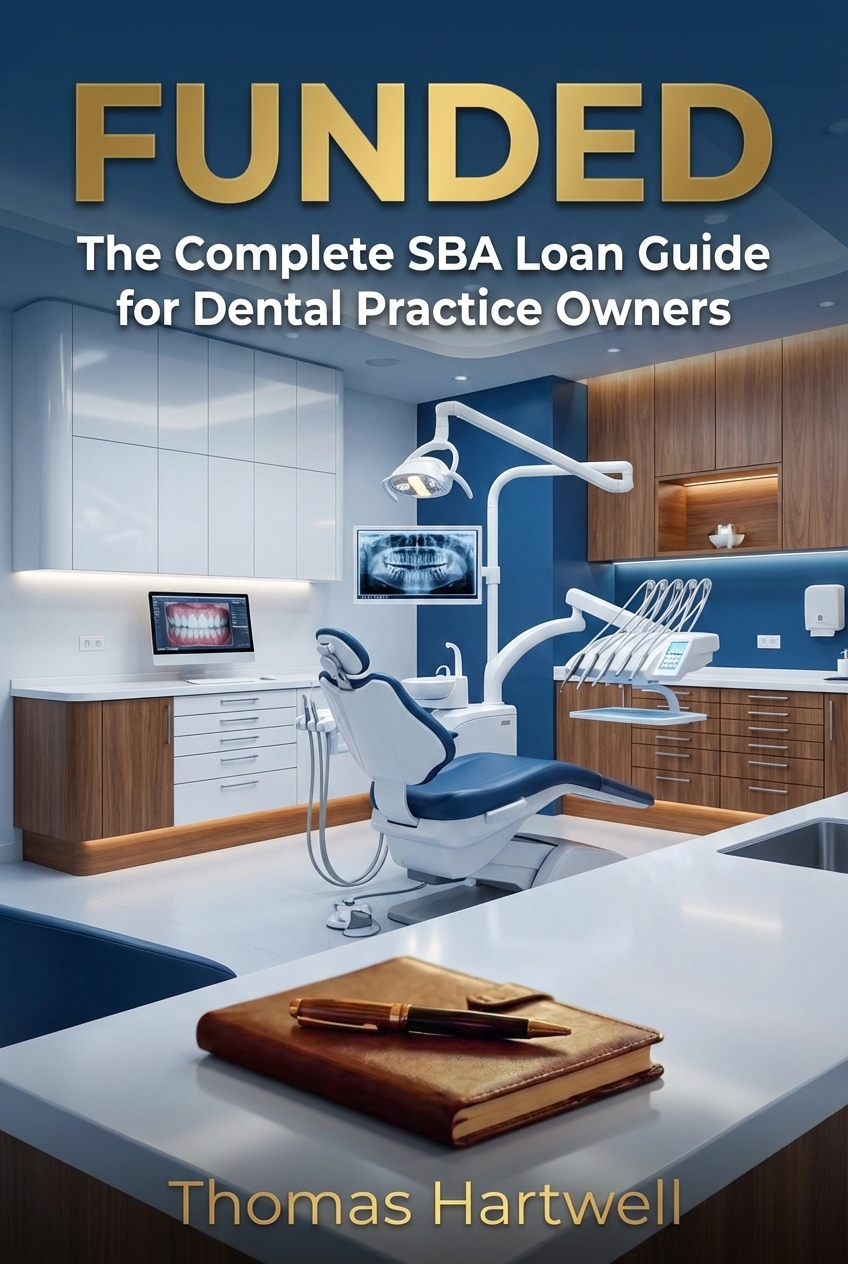
FUNDED Series
The Complete SBA Loan Guide for Dental Practice Owners
By Thomas Hartwell
ISBN: 979-8-9947079-7-5 (Paperback) | 979-8-9947079-6-8 (Ebook)
The definitive guide to SBA 7(a) and 504 loans for dental practice acquisitions, de novo startups, and multi-location expansions.
Available now on Amazon
What This Book Covers
Dental practice financing has unique challenges that generic SBA guides don't address. Goodwill-heavy valuations, six-figure student debt, insurance credentialing timelines, and the growing DSO-to-independent pipeline all require industry-specific guidance.
FUNDED: The Complete SBA Loan Guide for Dental Practice Owners covers everything from practice valuation and deal structuring to navigating student debt in your DSCR calculation. Whether you're acquiring an existing practice, opening a de novo location, or expanding to multiple offices, this guide shows you how to get funded.
What You Won't Find in Free Online Guides
- Goodwill-heavy valuation strategies — How to present a practice worth 80% goodwill to skeptical lenders
- Student debt DSCR calculations — How $300K in dental school debt affects your borrowing power and what to do about it
- DSO exit roadmap — Step-by-step guide to leaving a DSO and financing your own practice
- Insurance credentialing timelines — When to start, what to expect, and how to avoid billing gaps
Who This Book Is For
- Associate dentists ready to buy their first practice
- DSO-employed dentists transitioning to independent ownership
- Practice owners expanding to multiple locations
- Dentists buying their practice building with the business
- New graduates planning their path to practice ownership
Meet Nadia, Kevin, and Lisa
Throughout this guide, you'll follow three dentists through different SBA financing scenarios:
Dr. Nadia Saleh is an associate dentist buying an existing practice from a retiring owner for $680,000. The practice is 81% goodwill, and she carries $285,000 in student debt. Her challenge: structuring the deal when most of the value is intangible and student loans weigh on her DSCR.
Dr. Kevin Park is leaving a DSO to open a de novo practice with a total project cost of $575,000. He has clinical experience but zero business financials. His challenge: convincing lenders to fund a startup when all he has are projections and a non-compete from his DSO employer.
Dr. Lisa Huang owns a thriving 6-operatory practice and is expanding with a building purchase ($850,000 + $150,000 renovation) and a second practice acquisition ($420,000) for a total project of $1.52 million. Her challenge: coordinating two simultaneous SBA loans across different programs.
What's Inside
Chapter 1: Why Dental Practices and SBA Loans Are a Natural Fit
The dental ownership market, the goodwill problem, and the student debt factor.
Chapter 2: SBA Eligibility for Dental Practices
NAICS codes, entity structure, DSO affiliation tests, and licensing requirements.
Chapter 3: Practice Valuation and the Goodwill Challenge
Income, market, and asset approaches for dental-specific valuations.
Chapter 4: Choosing the Right SBA Program
SBA 7(a), 504, Express, and when to combine programs.
Chapter 5: Structuring the Acquisition Deal
LOI, purchase agreements, seller financing, and credentialing transitions.
Chapter 6: Financial Analysis and DSCR
DSCR calculations for acquisitions, startups, and multi-location deals with student debt.
Chapter 7: Equity Injection and Collateral
Sources of equity, the dental collateral gap, and standby seller notes.
Chapter 8: The Application Process
Finding the right lender, document checklist, and underwriting.
Chapter 9: Closing Day and the Transition
Patient communication, staff retention, and insurance credentialing.
Chapter 10: Post-Closing and Growth
SBA compliance, debt management, and planning your next move.
SBA Dental Practice Loan FAQ
Can I get an SBA loan to buy a dental practice?
Yes. SBA loans are one of the most common financing methods for dental practice acquisitions. Both SBA 7(a) and SBA 504 programs can be used. The key requirements are relevant dental experience, adequate down payment (typically 10%), acceptable credit (680+), and practice cash flow sufficient to cover debt payments.
How does student debt affect my SBA dental practice loan?
Student debt is factored into your global Debt Service Coverage Ratio (DSCR). Lenders add your student loan payments to your total debt obligations when calculating whether the practice generates enough cash flow. With average dental school debt around $300,000, this is a significant factor. Income-driven repayment plans can help by lowering monthly obligations.
What is the typical down payment for an SBA dental practice loan?
The SBA minimum is 10% equity injection. Most dental practice acquisitions can achieve 10% down, especially with experienced borrowers and strong practice cash flow. Seller standby notes can count toward your equity injection if structured properly with a 24-month full standby period.
How do lenders value a dental practice for SBA loans?
Dental practices are valued using income, market, and asset approaches. The key challenge is that 60-80% of a dental practice's value is goodwill (patient relationships, reputation, location), which creates a collateral gap since goodwill has no liquidation value. Lenders focus on collections, EBITDA, and patient retention rates.
Should I use SBA 7(a) or 504 for a dental practice?
SBA 7(a) is the most common choice for dental practice acquisitions because it covers the business purchase, equipment, and working capital in one loan. SBA 504 is better when real estate is a major component—like buying your practice building. Many expansion deals use both programs together.
Can I get an SBA loan for a dental startup (de novo practice)?
Yes, but startups are harder to finance because there are no historical financials. You need strong projections, relevant dental experience, a solid business plan, and typically a signed lease. SBA 7(a) is the standard program for de novo dental practices. Expect 10% equity injection on total project costs.
How long does it take to get an SBA loan for a dental practice?
Expect 60-90 days from application to funding for a well-prepared SBA dental practice loan. The timeline includes lender review (2-3 weeks), SBA approval (1-2 weeks for Preferred Lenders), appraisal and valuation (2-4 weeks), and closing (1-2 weeks). Insurance credentialing should start during the loan process.
What DSCR do lenders require for dental practice SBA loans?
Most lenders require a minimum DSCR of 1.20x to 1.25x for dental practice loans, calculated using practice cash flow after all debt payments including student loans. Acquisitions use historical financials; startups use projections with conservative assumptions.
Can I leave a DSO and buy my own dental practice with an SBA loan?
Yes. Many dentists transition from DSO employment to independent practice ownership using SBA financing. Key considerations include non-compete agreements (geographic and time restrictions), demonstrating P&L management experience, and building a business plan that shows your readiness for ownership.
What happens with insurance credentialing when I buy a dental practice?
Insurance credentialing is critical and time-sensitive. Start the credentialing process 90-120 days before closing. You need to be credentialed with insurance panels before you can bill under your own name. Many purchase agreements include a transition period where the seller remains to maintain billing continuity.
Can seller financing count as my SBA equity injection?
Seller standby notes can count toward your 10% equity injection if they meet SBA requirements: the note must be on full standby for 24 months (no payments of principal or interest) and must be subordinate to the SBA loan. This is common in dental practice sales.
What credit score do I need for an SBA dental practice loan?
Most SBA lenders require a minimum credit score of 680 for dental practice loans. Some will consider 650+ with compensating factors like strong practice cash flow, higher equity injection, or significant dental management experience.
Can I buy my practice building and the dental practice with SBA loans?
Yes. You can use SBA 504 for the building (lower rates, fixed CDC portion) and SBA 7(a) for the practice acquisition, equipment, and working capital. This dual-loan structure is common for dentists buying both the practice and the real estate.
How do I finance dental equipment with an SBA loan?
Dental equipment (chairs, X-ray machines, CAD/CAM systems, sterilization equipment) can be financed as part of your SBA 7(a) loan for acquisitions or startups. Equipment-only purchases may qualify for SBA Express loans up to $500,000 with faster approval.
What is the maximum SBA loan amount for a dental practice?
SBA 7(a) loans go up to $5 million. SBA 504 loans can reach $5.5 million for the CDC portion. Most dental practice acquisitions fall in the $400,000-$2 million range. Multi-location deals or practice-plus-building purchases may approach the maximums.
Free Dental SBA Resources
Dental SBA Loan FAQ
Answers to common dental financing questions
How to Buy a Dental Practice with an SBA Loan
Step-by-step acquisition guide
Dental Practice Valuation for SBA Loans
Goodwill-heavy valuations for lenders
Student Debt and SBA Dental Loans
How student loans affect your borrowing power
DSO to Independent Practice
Leaving a DSO to own your own practice
SBA 504 vs 7(a) for Dental Practices
Compare programs for your dental deal
Available Now on Amazon
Stop guessing about dental practice financing. Get the dental-specific SBA guidance you need.