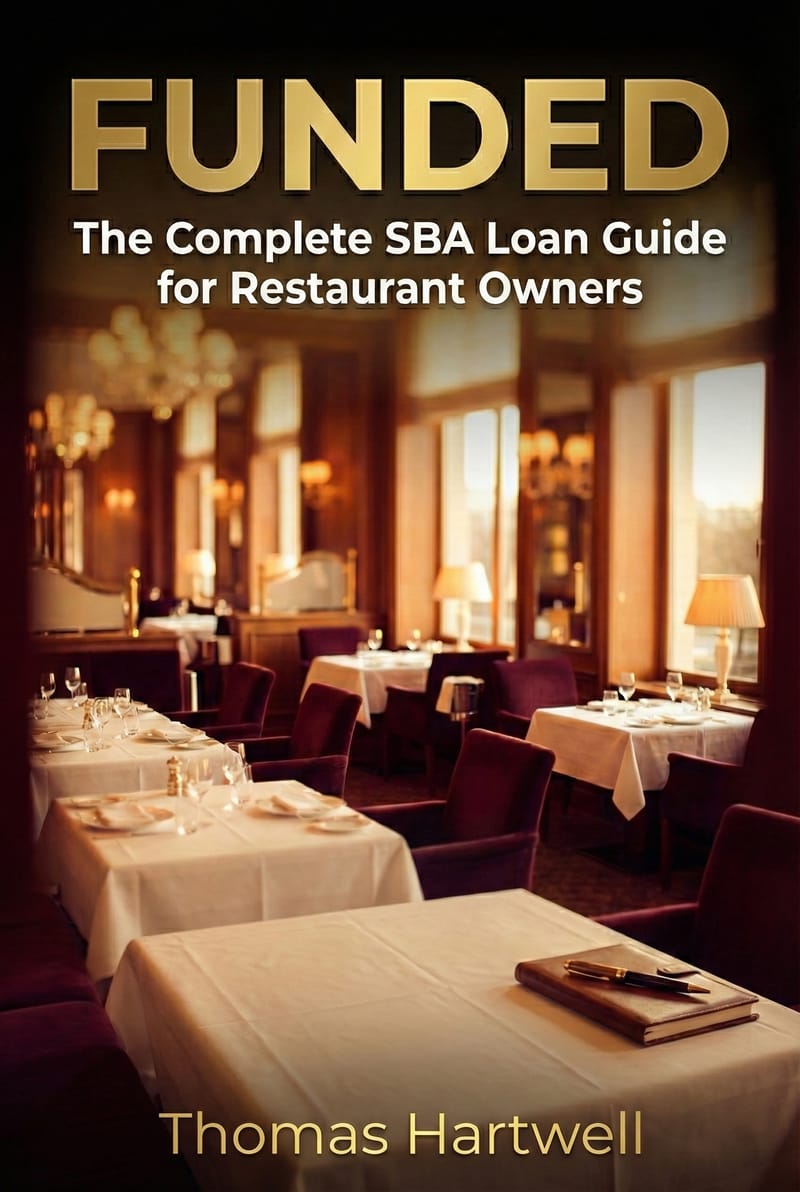
FUNDED Series
The Complete SBA Loan Guide for Restaurant Owners
By Thomas Hartwell
ISBN: 979-8-9947079-2-0 (Paperback) | 979-8-9947079-3-7 (Ebook)
The complete guide to securing SBA financing for restaurant acquisitions, expansions, and equipment purchases.
Available now on Amazon
What This Book Covers
Getting an SBA loan for a restaurant is different from getting one for any other business. Lenders view restaurants as higher-risk, they scrutinize food service experience more closely, and they apply stricter cash flow requirements. Generic SBA guides don't address these realities.
FUNDED: The Complete SBA Loan Guide for Restaurant Owners is written specifically for food service business owners. Whether you're buying an existing restaurant, expanding your current operation, financing equipment, or transitioning from a food truck to a brick-and-mortar location, this guide shows you exactly what lenders look for and how to structure your deal for approval.
What You Won't Find in Free Online Guides
- Actual deal walkthroughs — Follow Maria and Tony through every conversation, document, and decision
- Real numbers — Cash flow projections, DSCR calculations, and equity requirements with actual figures
- What lenders actually think — The internal criteria they won't tell you about directly
- How to handle weaknesses — Strategies for gaps in experience, credit issues, and thin cash flow
Who This Book Is For
- Restaurant owners looking to acquire or expand
- Food truck operators ready for a permanent location
- Entrepreneurs buying their first restaurant
- Existing owners refinancing or purchasing equipment
- Anyone who's been turned down and wants to understand why
Meet Maria and Tony
Throughout this guide, you'll follow two restaurant owners through the SBA lending process:
Maria is opening a new taqueria with a $450,000 project budget. She has 8 years of restaurant management experience but has never owned her own place. Her challenge: proving to lenders she can run her own business, not just manage someone else's.
Tony is acquiring an existing pizza shop for $800,000. The business is profitable, but the seller wants to retire quickly. His challenge: completing due diligence and closing the deal before the seller gets impatient.
What's Inside
Chapter 1: The Bank Call That Changes Everything
Why your bank said no, and what to do about it.
Chapter 2: SBA 7(a) vs 504 for Restaurants
Which program fits your deal—and when to use both.
Chapter 3: The Experience Question
How lenders evaluate food service experience and what counts.
Chapter 4: Cash Flow and DSCR
Restaurant-specific calculations lenders actually use.
Chapter 5: Equity Injection
Where your down payment can (and can't) come from.
Chapter 6: Equipment Financing
Financing kitchen equipment, POS systems, and buildouts.
Chapter 7: The Business Plan
What SBA lenders actually want to see.
Chapter 8: Finding the Right Lender
Preferred Lenders, SBA Express, and lender selection.
Chapter 9: The Application Process
Document checklists, timeline, and what to expect.
Chapter 10: Closing and Beyond
From approval to funding—and your ongoing obligations.
SBA Restaurant Loan FAQ
How do I get an SBA loan for a restaurant?
To get an SBA loan for a restaurant, you need relevant food service experience (or a qualified partner), 10-20% equity injection, acceptable credit (typically 680+), and a business that can service the debt. The process involves finding an SBA lender experienced with restaurants, submitting financials and projections, and closing—typically 60-90 days.
Can I get an SBA loan to buy a restaurant?
Yes. SBA 7(a) loans are commonly used for restaurant acquisitions. You can finance the purchase price, equipment, inventory, and working capital. Key requirements include food service experience, adequate down payment, and a property with sufficient cash flow (typically 1.15x-1.25x DSCR).
What credit score do I need for an SBA restaurant loan?
Most SBA lenders require a minimum credit score of 680 for restaurant loans, though some will consider scores as low as 650 with compensating factors like strong cash flow or significant equity injection. The SBA itself doesn't set a minimum score—individual lenders do.
How much down payment is required for an SBA restaurant loan?
The SBA requires a minimum 10% equity injection for most restaurant loans. However, lenders may require 15-20% for startups, change-of-industry borrowers, or deals with higher risk profiles. The equity must come from acceptable sources—not borrowed funds.
Can I use an SBA loan to buy restaurant equipment?
Yes. SBA 7(a) loans can finance restaurant equipment including commercial kitchen equipment, refrigeration, POS systems, and furniture. For equipment-heavy purchases, an SBA 504 loan may offer better terms with lower down payments for the equipment portion.
Do I need restaurant experience to get an SBA loan?
Lenders strongly prefer borrowers with relevant food service experience. However, you can compensate for lack of direct restaurant experience with related management experience, a strong operating partner, or comprehensive training from the seller.
How long does it take to get an SBA restaurant loan?
Expect 60-90 days from application to funding for a well-prepared SBA restaurant loan. Complex deals or incomplete applications can take longer. Starting with a complete document package significantly speeds up the process.
Why do banks consider restaurants high risk for SBA loans?
Banks view restaurants as higher risk due to industry failure rates, thin margins, and cash flow volatility. However, SBA loans mitigate lender risk through government guarantees. Borrowers with strong experience, adequate equity, and proven concepts can still get approved.
What DSCR do I need for an SBA restaurant loan?
Most lenders require a minimum Debt Service Coverage Ratio (DSCR) of 1.15x to 1.25x for restaurant loans. This means the business must generate $1.15-$1.25 in cash flow for every $1.00 of debt service. Higher ratios improve your approval odds.
Can I get an SBA loan to open a new restaurant?
Yes, but startup restaurants face stricter requirements than acquisitions. Expect to need more equity (15-20%), stronger personal credit, and significant food service management experience. A detailed business plan with realistic projections is essential.
Free Restaurant SBA Resources
Available Now on Amazon
Stop guessing what lenders want. Get the restaurant-specific SBA guidance you need.