


The Minimum Is 10%
For a business purchase with an SBA 7(a) loan, SOP 50 10 8.1 sets the minimum down payment at 10%. The SBA calls it an equity injection. For a first-time buyer, the rule says it cannot be reduced or eliminated.
You will often hear that purchasing a business takes 20 to 30 percent down. That is not the SBA's number. The SBA's minimum for a change of ownership is 10%.[1]
A first-time purchase is what the SBA calls an Initial Acquisition: the deal creates a new majority or largest owner who did not own part of the business before. For that deal type, the 10% is fixed.
Existing owners can land in this group too. An asset purchase is an Initial Acquisition even when an existing business is the buyer, and so is purchasing a business outside your own four-digit industry group. Only a Business Expansion or an Owner Buyout can have its 10% lowered.
The 10% is a floor, not a ceiling. Many lenders ask for more on some deals, and your lender decides what it will accept. If one lender's number is far above the SBA minimum, it can pay to ask another.
10% of What? The Whole Project
The 10% is based on the total project cost: in the SOP's words, "all costs required to become operational, regardless of the source of funds," except lines of credit and 504 loans. The price plus working capital and the other costs of the deal.
One word in the rule changes the math for most buyers. The word is project.
Say the price is $600,000 and the business needs $30,000 of working capital on day one. The project is $630,000, so the minimum down payment is $63,000.
Budget 10% of the price alone and you would plan for $60,000, and come up $3,000 short. On a bigger deal, with closing costs and equipment on top, that gap grows. Plan your cash around the project, not the price.
If real estate is part of the purchase, it carries the same 10%. When the real estate goes on a separate 504 loan, that piece follows the 504 rules further down this page.
Down Payment by Deal Type
Under SOP 50 10 8.1: Initial Acquisition 10% of total project cost, never waived. Business Expansion 10% of total project cost and Owner Buyout 10% of the purchase price, both waivable by the lender. Start-ups 10% of project cost. SBA 504 projects 10%, 15% or 20%.
The deal type sets both the percentage and what it is a percentage of. Your lender records the type in the SBA's system, so it is worth knowing which one your deal is before you talk numbers.
The loan program matters too: a 7(a), a 504 or a CAPLine each has its own down payment rule. The which SBA loan fits guide shows the down payment for each situation, with a free chooser.
The full table, with what each percentage is based on and whether the lender can lower it, is at the top of this page.
When the lender can lower it
For a Business Expansion or an Owner Buyout, the lender may reduce or eliminate the 10% if the business has enough liquidity and working capital to run after the deal.[2] The balance sheet cannot show a negative net worth at the last fiscal year-end.
The waiver has a cost. Once it is granted, the lender cannot put dedicated permanent working capital in that or any other 7(a) term loan within 90 days. Working capital has to come from existing cash or a line of credit.
Start-ups
The SBA treats a business operating 1 year or less as a start-up, and calls for at least 10% of the total project cost on 7(a) start-up loans.[3] SBA Express leaves the equity decision to the lender's judgment, while the start-up rule calls for 10% on 7(a) start-ups. On an Express start-up, expect your lender to ask for at least 10%.
Free: The 27-Point SBA Loan Checklist
See what lenders check before you apply, including how they verify where your down payment came from.
✓ You're in!
Your 27-point SBA loan checklist is downloading now, check your downloads folder. We've also added you to the list for SBA updates from Hartwell Labs.
Enter your email and we'll send you the free 27-point checklist instantly.
Enter your email and we'll send you the free 27-point checklist instantly.
No spam. Unsubscribe anytime. We'll also notify you of new book editions.
What Counts Toward Your 10%
On a business purchase, SOP 50 10 8.1 splits down payment sources into two groups. Unlimited: your own unborrowed cash (gifts included), a personal loan repaid from outside the business, clawback-free grants, verified prepaid expenses. Limited, together no more than half: a seller note on full standby, other standby debt, and a minority investor under 20%.
Unlimited sources
- Cash you did not borrow, on the business's balance sheet or from elsewhere. A gift counts.
- A personal loan to a guarantor, if you can show it will be repaid from something other than the business's cash flow. Your salary from the business does not qualify.
- A grant with no repayment or clawback provision during the 7(a) loan.
- Eligible prepaid expenses the lender has verified with paid invoices, canceled checks or bank statements.
Limited sources: no more than half, combined
- A seller note on full standby. It must be subordinated to the lender, and the seller receives no principal and no interest for the whole term of the 7(a) loan.
- Other debt on full standby, signed on SBA Form 155 or the lender's equivalent. Interest may build up and be paid after the SBA loan is paid off.
- A minority investor who owns less than 20% and has no control, with no deal to get the money back before the SBA guaranty is released.
This changed on October 1, 2026. Under the old SOP, the half limit applied to seller notes only, and investor money had no cap. Now the seller note and the investor share the same half.[4]
What does not count
- Fees for education, advisory services, or an Agent who helped with the loan.
- A seller note that pays the seller during the SBA loan term. It is debt, not equity, and its payments count against your cash flow test.
- A personal loan you plan to repay from the business's cash flow.
- A grant that could be clawed back during the loan.
The value of equipment or other non-cash assets you contribute is not on the SOP's source list for business purchases. If you plan to count one, ask your lender early.
A Worked Example: Marcus's Laundromat
Marcus, a first-time buyer, has a $630,000 project ($600,000 price plus $30,000 working capital). His minimum down payment is $63,000: $45,000 of his own cash plus an $18,000 seller note on full standby. The SBA loan is $567,000.
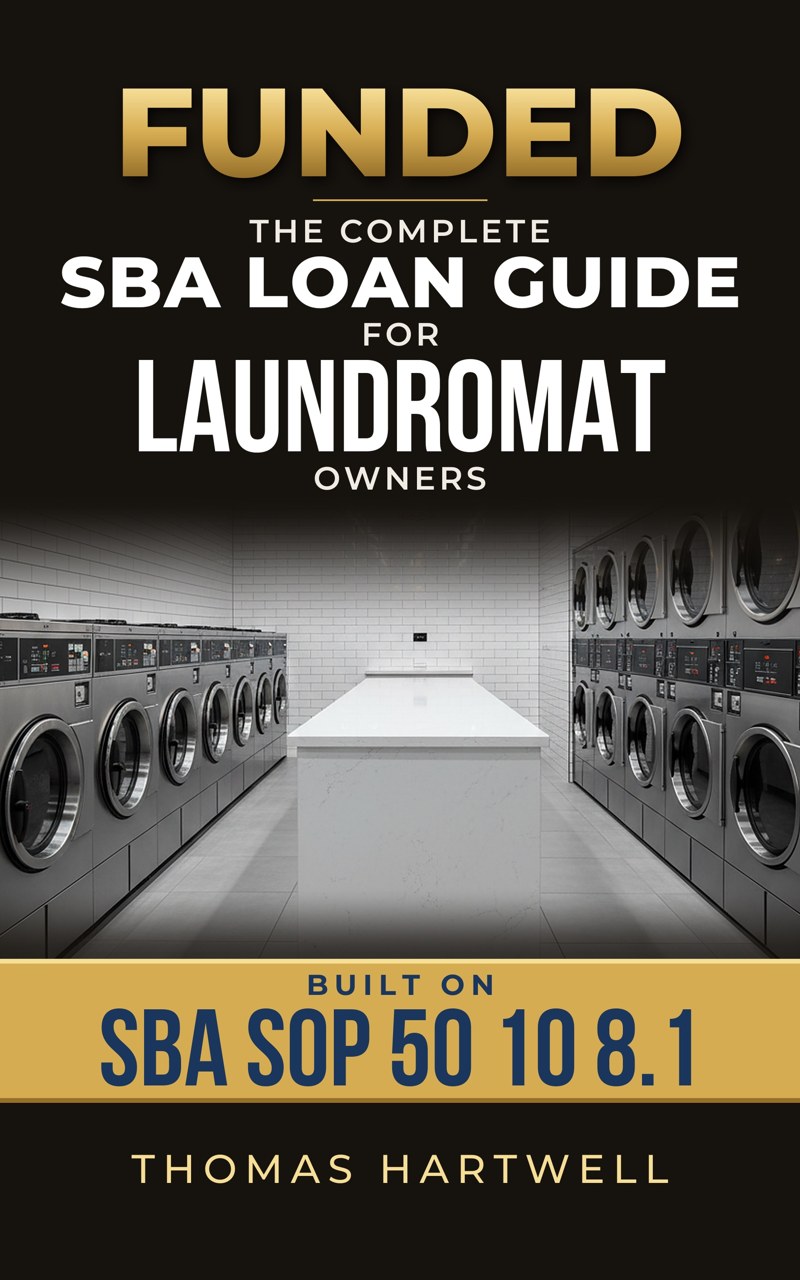
Marcus Bell is purchasing an existing laundromat, the main deal in the FUNDED Laundromat guide. It is his first business, so his deal is an Initial Acquisition and his 10% cannot be waived.
The $40,000 the lender counted as $0
The seller asked $680,000. He said the store takes in another $40,000 a year in cash that never made it onto the tax return. The lender counted zero. The SOP has the lender check the numbers against the tax returns and the seller's IRS transcripts, so cash nobody reported does not support the price.
The price above the valuation
Because the price was over $350,000, the lender ordered an independent valuation. It came in at $620,000. The SOP says that when the price is above the valuation, the difference must be made up by equity.[5]
At the full asking price, Marcus would have owed that $60,000 gap out of pocket, on top of his 10%. He negotiated the price to $600,000 instead.
There is also a debt limit: all the debt in the deal can't add up to more than the valuation. His loan plus his seller note come to $585,000, under the $620,000 value.
Where he landed
The SBA loan is $567,000 on a 10-year term. The store's documented cash flow was $150,000, against payments of about $79,880 a year at an illustrative 7.25% rate. That is coverage of 1.88, over the 1.25 floor. It clears the SBA minimums, and his lender decides. His whole deal, step by step, is in the Laundromat book.
Your Choices: Cash, a Seller Note, or a Smaller Price
You have three ways to meet the 10%. Bring more cash, ask the seller to carry up to half on full standby, or lower the project cost by negotiating the price. Each one trades something.
More cash
Cash is the simplest source. It has no cap and no standby paperwork. The trade-off: every dollar in the down payment is a dollar you don't keep as a cushion after closing.
A seller note on full standby
A standby note lets you keep more cash in hand. The cost is the wait. On a 10-year SBA loan, the seller gets nothing on that note for ten years, and many sellers say no.
If the seller wants to be paid along the way, the note stops counting toward your 10%. Its payments also go into your cash flow test.
A smaller price
Every $10,000 off the price takes $10,000 off the project and $1,000 off your 10%. A lower price can also close a gap between the price and the valuation, as Marcus found.
SBA 504 Down Payment: 10%, 15% or 20%
An SBA 504 borrower contributes at least 10% of the project. A new business or a limited or special purpose property raises it to 15%. A project that is both needs 20%. The 504 contribution may be borrowed if it is subordinate to the bank loan and the debenture.
A 504 loan finances real estate and major fixed assets. In the usual structure, a bank lends 50% or more, a Certified Development Company (CDC) lends up to 40%, and you put in the rest.[6]
What "new business" means here
For 504, a new business is one operating 2 years or less when the loan is approved. A change of ownership can also count as new when it brings unproven owners and added debt. That is a longer window than the 1-year start-up test on 7(a).
Special purpose property
The SBA keeps a list of limited or special purpose properties. Car washes, gas stations and hotels are on it. The CDC decides whether your property qualifies and explains why in its credit memo.
Borrowing the contribution
On a 504, your contribution may be borrowed, as long as the debt is subordinate to the bank loan and the 504 debenture. The percentage also leaves out administrative costs. On a 7(a) purchase, borrowed money counts only as a personal loan repaid from outside the business, or as standby debt under the half cap.
How to Work Out Your SBA Down Payment
- 1
Name your deal type
First-time purchase (Initial Acquisition), Business Expansion, Owner Buyout, start-up, or a 504 project. The type sets the percentage and whether a lender can lower it.
- 2
Add up the whole project
Price plus working capital and every other cost required to become operational. For an Owner Buyout, use the purchase price instead.
- 3
Take the minimum percentage
10% on a 7(a) purchase or start-up. On a 504 project, 10%, 15% or 20% depending on whether the business is new and the property is special purpose.
- 4
Sort your sources
Put your own cash, gifts, clawback-free grants and an outside-repaid personal loan in the unlimited group. Put a standby seller note, other standby debt and minority investor money in the limited group.
- 5
Check the half cap
On a business purchase, the limited group together can cover no more than half of the minimum. On a $63,000 requirement, that is $31,500. Temporary exception: from November 11, 2026 through September 30, 2027, the SBA has announced that an eligible veteran purchasing an existing business with a 7(a) loan may raise the full 10% from the limited group (SBA News Release 26-117); ask your lender how it applies.
- 6
Compare price to valuation
If the price is above the independent valuation, plan to cover the gap with more equity, or negotiate the price down.
- 7
Ask your lender
These are SBA minimums. Ask early what your lender will require on your deal, and ask a second lender if the answer is far above them.
Want the full walkthrough, with real deals worked step by step?
Get the FUNDED SeriesRelated SBA Lending Guides
- What Changed in SOP 50 10 8.1, the October 1, 2026 rule changes in one place
- SBA Loan Requirements, credit, equity, cash flow and experience
- How Much Can You Borrow?, the program limits and what actually sizes your loan
- Can You Use an SBA Loan to Buy a Business?, every purchase rule in plain words
- SBA Startup Loans, the down payment and other rules for a new business
- SBA Loan Rates, the 7(a) maximum rates by loan size
- SBA 7(a) vs 504, which program fits your project
- SBA Collateral Requirements, what lenders take and when your home is in play
- Global DSCR for SBA Loans, the household cash flow test
- SBA Down Payment Calculator, your minimum and what counts
- The FUNDED Series, one SBA lending guide per industry