

SBA gym loans by the numbers
From FY2015 through June 30, 2026, the SBA approved 11,735 loans to fitness and recreational sports centers under 7(a) and 939 under 504, net of cancellations.[1] Gym lending is mostly new studios and franchises, not purchases.
SBA gym and fitness loans (NAICS 713940)
| Measure | Figure |
|---|---|
| Median 7(a) loan, FY2015 to June 2026 | $229,000 (all industries: $150,000) |
| 7(a) loans that open a new business (FY2019 on) | 54.2% (all industries: 16.6%) |
| Start-ups with a franchise code (FY2019 on) | 68.6%, median $350,000 |
| Purchases of an existing gym (FY2019 on) | 6.8% of 7(a) loans, median $300,000 (all industries: 11.1%) |
| All gym loans with a franchise code | 45.0% (all industries: 11.7%) |
| Charged off, 7(a) loans approved FY2010 to FY2016 | 9.3% of loans, 4.1% of dollars (all industries: 7.0% and 3.1%) |
Source: SBA 7(a) and 504 FOIA loan data as of June 30, 2026. NAICS 713940 also covers skating rinks, pools and racquet clubs. Read the charge-off rate with its timing: 28.0% of those gym charge-offs are dated 2020 to 2022, against 20.6% for all industries.
That 2020 history is why lenders look hard at gym reserves. Private employment at fitness centers fell 31.1% from 2019 to 2020 and didn't pass its 2019 level again until 2025.[2] Expect questions about how long your cash would carry the business if revenue dropped.
Three ways into a gym
- Opening a studio or gym is a start-up, judged on projections. At least 10% of total project cost, and coverage of 1.15 within two years on Standard 7(a).[3]
- Purchasing a gym as a first-time owner is an Initial Acquisition. At least 10% down that can't be waived, and the seller's history must show 1.25 coverage.
- Adding a second location can qualify as a Business Expansion at a 1.15 floor, but only if your gym purchases 100% of a business in the same four-digit industry group.
The size limit for fitness and recreational sports centers is $17.5 million in average annual receipts, and in a purchase the gym you acquire is counted together with yours.[4]
Eligibility rules written for gyms
A few SBA rules reach gyms directly, and each one is settled before anyone looks at your numbers.
- Open to both men and women. SOP 50 10 8.1 says a men's or women's only health club is not eligible. A gym that markets to one gender can be eligible if both can join and use it, and the lender files your affidavit plus evidence such as locker rooms for both or membership records.
- Membership caps. Federal rules bar private clubs that limit memberships for reasons other than capacity.[5] If a founding-member cap is about exclusivity rather than floor space, ask your lender before you apply.
- For-profit only. Nonprofits can't use 7(a) or 504, which leaves out YMCAs and similar centers. Tax-exempt centers took in 19.2% of the industry's receipts in the 2022 Economic Census.
- Management agreements. If a manager has sole discretion over the gym, it is an ineligible passive business. An owner who keeps a day job must still approve the budget and large purchases, control the bank accounts and oversee staff who are the gym's own employees. A management company that is, or is affiliated with, your franchisor makes a franchisee ineligible.
Renting space to outside trainers
The SBA bars businesses that earn income by renting space to independent businesses serving the public, unless the revenue is membership dues, nobody has an assigned space, and the business supplies the equipment. It also says a business is either fully eligible or fully ineligible: a model that mixes rent and dues is not eligible. Whether your lender treats a gym that charges trainers rent for a room as that kind of model is the lender's call. If it does, there is no small-share exception. Raise any trainer rent before you sign a lease or a letter of intent.
Opening a franchise studio
If your brand meets the FTC definition of a franchise, it must be on the SBA Franchise Directory for the loan to be made.[6] Your lender checks it when you apply. The lender also reviews what the franchisor discloses, such as the number of failed franchisees and the franchisor's projections.
In the book's main start-up example, Keisha Dawson, a coach and studio manager for eight years, opens a franchise strength studio in a leased strip-center bay. The brand is marketed mostly to women and open to everyone, so her lender files her affidavit and the evidence.
Keisha's franchise studio
| Item | Amount |
|---|---|
| Build-out / equipment | $330,000 / $150,000 |
| Franchise fee / working capital | $60,000 / $60,000 |
| Total project cost | $600,000 |
| Equity (10%, from savings) | $60,000 |
| Standard 7(a) loan | $540,000, 10 years |
| Annual debt service at an illustrative 7.50% | $76,919 |
| Projected cash flow, year 1 / year 2 | $32,000 / $98,000 |
| Projected coverage, year 1 / year 2 (floor 1.15 within 2 years) | 0.42 / 1.27 |
| Household (global) coverage, year 2 | 1.23 (floor 1:1) |
| Upfront guaranty fee, FY2027 | $12,150 on the $405,000 guaranteed portion |
Year 1 falls $44,919 short of the payments. The $60,000 of working capital in the loan plus the $55,000 left in her savings cover it.
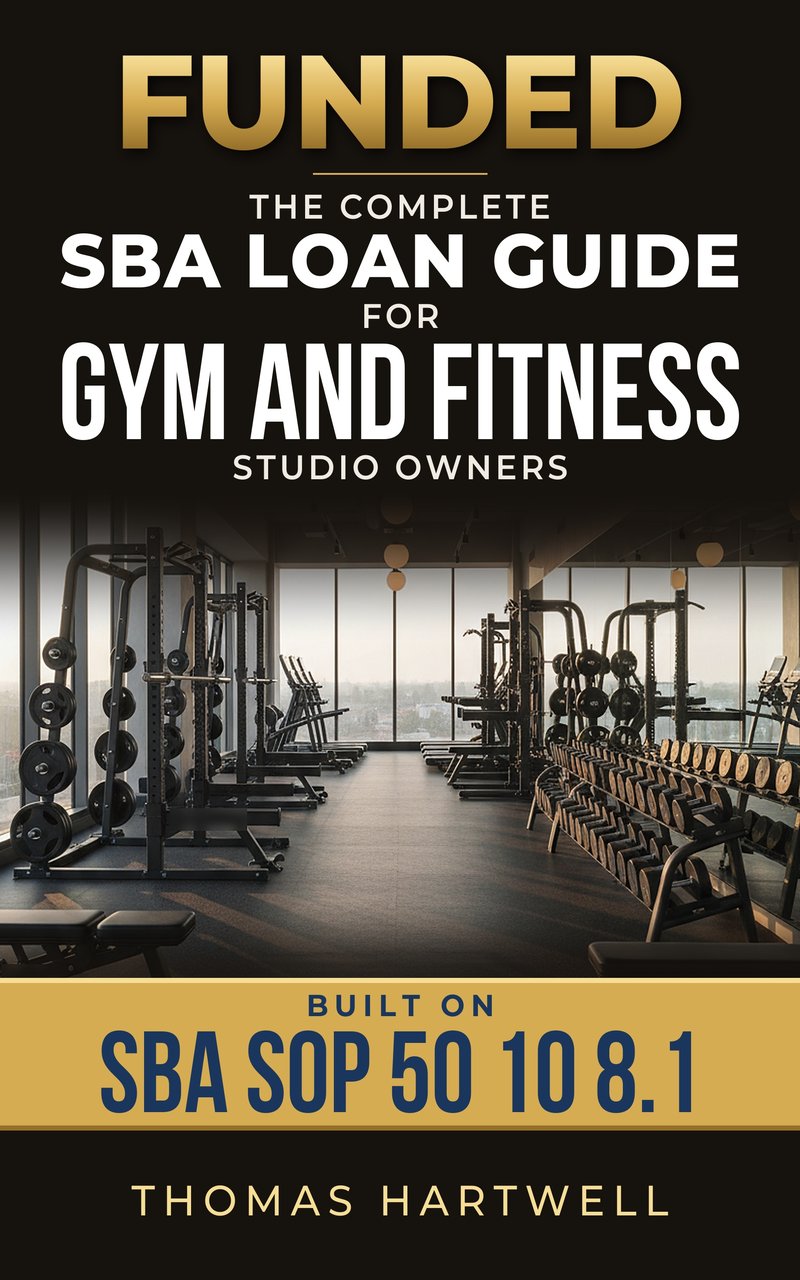
For detailed calculations and real examples, see the FUNDED Gym and Fitness Studio Guide (coming soon).
Her loan is over the $500,000 SBA Express cap, so Standard 7(a) is the route. On a smaller studio, SBA Express leaves the equity decision to the lender while the start-up rule calls for 10%, so expect an Express lender to ask for at least 10% too. One thing to settle early: Keisha has already paid part of her franchise fee. Verified prepaid expenses can count toward equity, but education, advisory and loan agent fees can't, and whether a franchise fee counts is her lender's call. Ask in writing before you pay it.
The lease, the build-out and the equipment
- The lease trigger. When leasehold improvements take the lesser of $500,000 or 30% of the loan, the lender must get the lease. On Keisha's loan that line is $162,000, and her $330,000 build-out is over it. Her lease runs 10 years plus 10 years of renewals only she can exercise, longer than the loan.
- The term. Leasehold improvements can run 10 years plus up to 12 more months while the build-out is finished. Working capital runs 10 years at most.
- Construction bonds. At $350,000 or less of construction, the SBA waives the bond requirements when the lender applies its own construction-risk policies. Keisha's $330,000 qualifies.
- Equipment as collateral. New equipment counts at up to 75% of its price, used equipment at 50% of net book value, and furniture and fixtures at 10%. Leased machines belong to the leasing company and count for nothing.
- Insurance. Hazard insurance is required on pledged collateral for 7(a) and 504 loans over $50,000. Leased space with no leasehold deed of trust pledged needs no SBA environmental review, though your lender may ask for one.
Purchasing a gym: the prepaid dues problem
In the book's purchase example, Nicole Barrett, who has managed someone else's gym for nine years, purchases an independent 24-hour gym across town for $650,000 in leased space. She has never worked for the gym she is purchasing, so the deal is an Initial Acquisition. Members have already paid the seller $90,000 for months he won't be around to serve.
SOP 50 10 8.1 never mentions prepaid memberships. It gives a buyer two tools instead.
- The working-capital true-up. A purchase agreement can include a working-capital adjustment, and the SOP says cash sent to the borrower under one may be kept for working capital rather than paid against the loan. Nicole's true-up sends her the $90,000, which she keeps to serve those members. It is not part of her equity.
- The cash flow adjustment. The seller's cash-basis results can look stronger after a paid-in-full promotion late in the year. Nicole's lender netted prepayments at the start and end of the year and backed out $40,000 collected for later months, leaving $122,000 of the $162,000 reported. Every adjustment has to be justified in the lender's credit memo.
Your state may add its own rules on a sale: notice to members, a new registration or bond, or new cancellation rights. Your state decides, so ask your attorney before you sign. Separately, the lender needs evidence of every license the gym needs to operate within 90 days after the loan finishes funding.
The seller who coaches
In many independent gyms the owner also coaches the popular classes. In an Initial Acquisition, the seller may not stay as an officer, director, stockholder or employee. The gym may hire the seller as a consultant for no more than 24 months in total. Nicole's seller consults for 6 months, with the class handoff written into the agreement. Retention worries can't be solved with an earnout, which the SBA prohibits; a buyer rebate is allowed, and it pays down the loan.
How a lender counts the collateral
How a lender counts Nicole's collateral
| Asset | Value | Counted toward fully secured |
|---|---|---|
| Owned used equipment | $210,000 net book value | $105,000 (50%) |
| Furniture and fixtures | $40,000 | $4,000 (10%) |
| Retail inventory (lien required in a purchase) | $12,000 | $1,200 (10%) |
| Leased cardio machines | Owned by the lessor | Nothing |
| Goodwill and the member base | Rest of the price | Nothing |
| Total against a $639,000 loan | $110,200; shortfall $528,800 |
Used equipment can count at up to 80% of orderly liquidation value with an appraisal. In a purchase, the lender must take a lien on the gym's receivables and inventory.
For detailed calculations and real examples, see the FUNDED Gym and Fitness Studio Guide (coming soon).
When the loan isn't fully secured, the lender must take available equity in personal real estate an owner of 20% or more owns alone, though not where the equity is under 25% of the property's value. For a home owned jointly with a spouse, the lender must consider a lien. On a Standard 7(a) loan for a business that depends on one owner, the SBA also requires life insurance in the amount of the shortfall, and an existing policy may be pledged. A shortfall alone is not a reason to decline the loan.
Down payment and seller notes on a purchase
For a first-time buyer, the SBA minimum is 10% of total project cost, and it can't be reduced or waived. A seller note counts toward it only on full standby, meaning no principal or interest for the life of the SBA loan, and limited sources like that can cover no more than half of the required injection. A temporary exception for veterans: from November 11, 2026 through September 30, 2027, the SBA has announced that an eligible veteran purchasing an existing business with a 7(a) loan may raise the full 10% from these sources (SBA News Release 26-117); ask your lender how it applies. Total debt, including any seller note that isn't on full standby, can't exceed the independent business valuation.
Nicole needed $71,000. She put in $46,000 of cash, and the seller carried $25,000 on full standby for the full 10-year term, under the half cap of $35,500. Many lenders ask for more than the minimum. No SBA line of credit can fund a purchase, so plan on a term loan.
Free: the 27-Point SBA Loan Checklist
Includes the equity, collateral and license checks above, in the order a lender works through them.
✓ You're in!
Your 27-point SBA loan checklist is downloading now, check your downloads folder. We've also added you to the list for SBA updates from Hartwell Labs.
Enter your email and we'll send you the free 27-point checklist instantly.
Enter your email and we'll send you the free 27-point checklist instantly.
No spam. Unsubscribe anytime. We'll also notify you of new book editions.
Nicole's deal, start to finish
Every number below comes from the book's worked example. The interest rate is illustrative.
Purchasing an independent gym through SBA 7(a)
| Item | Nicole's deal |
|---|---|
| Receipts on last tax return (memberships, personal training, day passes) | $1,050,000 |
| Purchase price, business only | $650,000 |
| Independent business valuation | $665,000 |
| Closing costs / working capital | $20,000 / $40,000 |
| Total project cost | $710,000 |
| Equity injection (10%) | $71,000: $46,000 cash + $25,000 seller note on full standby |
| SBA 7(a) loan | $639,000, 10 years |
| Annual debt service at an illustrative 7.50% | $91,021 |
| Cash flow after a market manager salary, less $40,000 of dues for later months | $122,000 |
| Debt service coverage | 1.34 (floor 1.25) |
| Global (household) coverage | 1.19 (floor 1:1) |
| Upfront guaranty fee, FY2027 | $14,377.50 on the $479,250 guaranteed portion |
The $90,000 true-up for prepaid dues is separate from the $40,000 of working capital in the loan. The price is under the $3,000,000 line where a Quality of Earnings report would be required.
For detailed calculations and real examples, see the FUNDED Gym and Fitness Studio Guide (coming soon).
Adding a second location
Ben Kowalski has run his gym for seven years. His company purchases 100% of a second gym across town for $900,000, in leased space, valued independently at $920,000. Both gyms are coded 713940, in the same four-digit group, so it qualifies as a Business Expansion. The second gym keeps operating as its own company, so it signs as a Co-Borrower.
Coverage is measured on both gyms' cash flow over all the debt payments after the deal. His gym's $180,000 plus the target's $120,000 covers $178,583 of combined debt service 1.68 times against a 1.15 floor. The target alone would come to 1.01. His $92,500 of equity could have been reduced or waived on an expansion, but waiving it would bar dedicated working capital in any 7(a) term loan for 90 days. His loan is $832,500, and the upfront fee is $21,853.13.
The yoga studio trap
A yoga studio down the street looks like the same kind of deal. To an SBA lender it isn't. The studio is coded 611699, in group 6116, so Ben's purchase would be an Initial Acquisition. The code follows where the revenue comes from: a business earning mostly from classes looks like a school, one earning mostly from memberships looks like a fitness center.
Same buyer, two targets
| Rule | Second gym (713940) | Yoga studio (611699) |
|---|---|---|
| Category | Business Expansion | Initial Acquisition |
| Coverage floor | 1.15, both gyms together | 1.25 |
| Equity | $92,500; lender may reduce or waive it | $25,000; can't be reduced or waived |
| Loan / annual debt service | $832,500 / $118,583 | $225,000 / $32,049 |
| Coverage in the book's example | 1.68 combined | 1.62 on the studio alone |
| Valuation | Independent, price over $350,000 | Lender may value it itself at $350,000 or less, unless buyer and seller have a close relationship |
The yoga deal still works on these numbers. On a thinner deal, the higher floor and the fixed equity can decide it. Pull the code from the target's tax return before you make an offer.
For detailed calculations and real examples, see the FUNDED Gym and Fitness Studio Guide (coming soon).
Owning the building through SBA 504
Later, Ben's landlord offers to sell the $1,800,000 building his first gym leases. A 504 loan pairs a bank loan with a Certified Development Company loan funded by an SBA-backed debenture. As an existing business, Ben contributes 10% ($180,000), his bank lends $900,000 (50%, his chosen structure) and the CDC lends $720,000. If the CDC concluded the building is Limited or Special Purpose, his contribution would rise to $270,000 and the debenture would fall to $630,000.
Once his company owns the building, it stops paying $96,000 a year in rent. Both gyms' $300,000 plus that rent covers $311,910 of total debt service 1.27 times against the 504 floor of 1.15, before the property taxes, insurance and repairs he now pays himself. Because the CDC adjusts cash flow for the rent, it must also prepare a household cash flow. In the book's example, Ben chooses to wait for a full year of combined results before purchasing the building. The debenture needs 8 jobs at one per $95,000, and he keeps 22. The 504 upfront fee is $3,600.
Which SBA program fits a gym deal
Which program fits which deal
| Your deal | Usual program | Minimum you put in |
|---|---|---|
| Opening a studio or gym in leased space | Standard 7(a), 7(a) Small or SBA Express | 10% of total project cost (on Express, the lender decides) |
| Purchasing an existing gym as a first-time owner | SBA 7(a), 10 years | 10% of total project cost, can't be waived |
| Your gym purchasing 100% of another gym in group 7139 | SBA 7(a) | 10%; your lender may reduce it |
| Your gym purchasing a studio in another code group | SBA 7(a) | 10%, can't be waived |
| Purchasing or building a gym building | SBA 504 | 10% existing business, 15% new business or if the CDC finds Special Purpose, 20% if both |
Goodwill and receivables can't go in a 504, so a gym purchase with goodwill uses 7(a), with any building in a separate 504 or on a blended 7(a) term.
For detailed calculations and real examples, see the FUNDED Gym and Fitness Studio Guide (coming soon).
On fees, FY2027 loans of $150,001 to $700,000 pay 3% of the guaranteed portion, and the 0% upfront fee reaches a gym only if the loan is $700,000 or less and the gym is in a rural county. On a 504, the 0.50% upfront fee and the annual fee are both waived in a rural county.
How to finance a gym or fitness studio with an SBA loan
- 1
Run the eligibility screens
Both genders can join, membership caps are about capacity, no trainer rent mixed with dues, and you keep control of budget, bank accounts and staff.
- 2
Check the brand and the code
A franchise brand must be on the SBA Franchise Directory when you apply. For a purchase, pull the target's NAICS code from its tax return.
- 3
Build the project budget
Include build-out, equipment, the franchise fee, any state health club bond and enough working capital to carry year one.
- 4
Plan the equity
10% of total project cost for a start-up or first purchase. Ask in writing whether a franchise fee you already paid will count.
- 5
Account for prepaid dues
Get a schedule of every prepaid membership, put a working-capital true-up in the letter of intent, and expect the lender to adjust the seller's cash flow.
- 6
Line up the seller's exit
In a first purchase or an expansion, the seller can stay only as a consultant, for no more than 24 months. Use a rebate, never an earnout.
- 7
Run coverage twice
Divide documented cash flow by annual debt service for the business test, then run the household global test at 1:1 or better.